
Wondering whether the sea can help cool the planet? Ocean climate solutions are ways to cut or remove carbon using the ocean; researchers see promise, but scale, measurement and risks remain unproven.
| Item | Value |
|---|---|
| Share of Earth’s surface covered by the ocean | About 70% |
| Share of emitted CO2 removed by natural land and ocean processes | Roughly 55% |
| Atmospheric CO2 compared with the past (as of 2021) | Higher than at any time in the past 800,000 years |
| National Academies ocean-based CDR research strategy | Published 2022 |
| Latest National Academies marine CDR update | Announced September 17, 2026 |
| LOC-NESS alkalinity field trial in the Gulf of Maine | Completed August 2025 |
These figures come from the National Academies project page and the Woods Hole Oceanographic Institution news release. Figures and findings can change as new research appears, so check the sources before you rely on them.
What are ocean climate solutions?
The phrase covers a wide set of ideas, and it helps to split them by purpose. Some aim to reduce emissions in the first place, while others try to take carbon dioxide out of the air or water after it has been released. Mixing the two up is the most common source of confusion in headlines.
This guide is independent and educational. It is not tied to any company, agency or project, and it does not sell services or take enquiries. Its job is to explain the landscape in plain language and point you to the sources behind each claim.
A simple way to sort the field:
- Cutting emissions with ocean energy. Using waves, tides, currents and offshore wind in place of fossil fuels.
- Removing carbon dioxide. Approaches that try to increase how much carbon the sea takes up and keeps, often called marine carbon dioxide removal, or marine CDR.
- Protecting and restoring ecosystems. Looking after coastal and marine habitats that already hold carbon.
- Understanding the system. Research, monitoring and measurement that tell us whether any of it works.
The rest of this guide spends most of its time on the second item, because that is where the open questions are largest. If you want the focused version, the page on marine carbon dioxide removal goes deeper on the core idea.
Why the ocean matters for carbon
The National Academies describe the ocean as covering about 70% of the Earth’s surface, and as already buffering a large fraction of human-caused CO2 emissions. That is why so much of the planet’s natural capacity to store carbon sits in the sea. The same page notes that natural processes on land and in the ocean have removed roughly 55% of emitted CO2, as stated on the National Academies project page.
That second figure is the reason researchers ask a practical question. If nature already absorbs a large share of emissions, could people help it absorb more, and keep that carbon locked away for longer? The same source says it may be possible to enhance both the uptake and the longer-term storage of these processes.
The need is not abstract. The National Academies’ 2022 research strategy notes that, as of 2021, atmospheric carbon dioxide had reached levels higher than at any time in the past 800,000 years. It adds that worldwide efforts to cut emissions with a more efficient, carbon-free energy system may not be enough on their own to stabilize the climate, according to the project page.

None of this means the ocean is a bottomless sink. It means the ocean is a large, active part of the carbon cycle, and that changing how it behaves, even a little, could matter. It also means that any intervention can have knock-on effects that are hard to predict.
The main approaches to marine carbon removal
The National Academies’ 2022 study was asked to look at a defined list of approaches. As stated in its task description, they were recovery of ocean and coastal ecosystems (including large marine organisms), iron, nitrogen or phosphorus fertilization, artificial upwelling and downwelling, electrochemical approaches, seaweed cultivation and ocean alkalinity enhancement. The sections below follow that list in plain terms.
Each idea works differently, carries different risks and is at a different stage of testing. Treat the short descriptions here as orientation rather than a verdict on any one method.
Ocean alkalinity enhancement
The idea behind ocean alkalinity enhancement is to change the chemistry of seawater so that it can hold more dissolved carbon. It is a chemistry-led approach rather than a biology-led one. That makes it easier to describe on paper than to measure at sea.
A real-world example comes from Woods Hole Oceanographic Institution. Its scientist Adam Subhas leads the Locking Ocean Carbon in the Northeast Shelf and Slope project, known as LOC-NESS, which examines the effectiveness and environmental impacts of alkalinity enhancement through field experiments, modelling, laboratory studies and monitoring. The team completed a field trial in the Gulf of Maine in August 2025, according to the WHOI news release.
Artificial upwelling and downwelling
Water in the sea moves up and down as well as sideways. Artificial upwelling refers to engineered ways of moving water vertically, and downwelling is the reverse. The goal is to alter where nutrients and carbon end up in the water column.
Because these methods interfere with natural circulation, researchers pay close attention to side effects on the surrounding ecosystem. Those effects are part of what the field still has to establish.
Iron and other nutrient fertilization
The thinking behind ocean iron fertilization is to add a limiting nutrient to surface water to encourage the growth of microscopic plant-like organisms, which take up carbon as they grow. The National Academies list covers iron, nitrogen or phosphorus. The open question is how much of that carbon stays stored rather than returning to the air.
This is one of the more debated ideas because it changes the base of the food web. That is exactly why independent research and careful governance feature so heavily in the official reports.
Seaweed cultivation
Growing seaweed is familiar farming, and the climate question is what happens to the carbon afterwards. The page on seaweed farming carbon sequestration looks at that gap between growing biomass and proving that carbon is kept out of the atmosphere over a meaningful period.
The same measurement problem applies here as elsewhere: a plant that grows is not the same thing as carbon that is reliably stored.
Coastal and marine ecosystem recovery
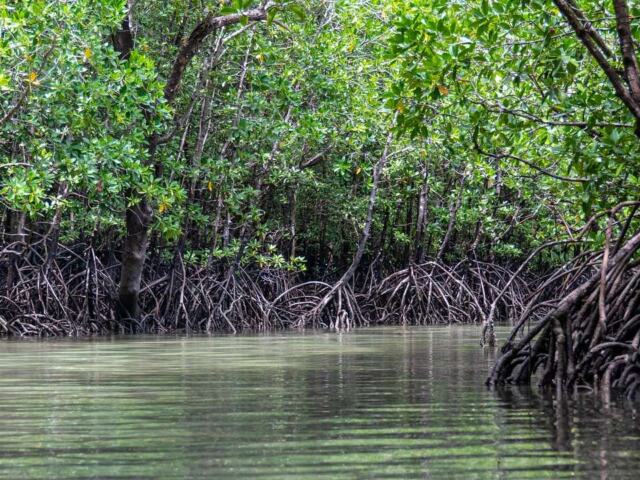
Restoring and protecting habitats is the most intuitive item on the list. The topic of blue carbon covers carbon held in coastal and marine ecosystems, and mangrove carbon storage looks at one well-known coastal example. The National Academies list also includes large marine organisms within this category.
Habitat recovery tends to bring other benefits, such as support for wildlife and coastlines. Whether its carbon effect can be counted precisely is a separate question.
Electrochemical approaches
The National Academies list includes electrochemical ocean CDR approaches, which use engineered systems rather than biology. The topic of direct ocean capture explains the engineered end of the field in more detail.
Engineered systems raise their own questions about energy use, scale and what happens to the water that is processed. Those questions are why testing and independent measurement matter.
Ocean energy and the wider science
Not every ocean climate solution is about removing carbon. Energy from the sea can reduce the emissions that make removal necessary in the first place, and the page on ocean renewable energy covers that side of the picture.
It is worth keeping the two separate in your mind. Removal is meant to supplement emission cuts, not replace them. The 2026 National Academies report says marine CDR, if demonstrated to be feasible and responsible, could supplement reductions in greenhouse gas emissions, as reported in the WHOI news release.
Every approach above rests on understanding how the ocean works: its chemistry, its currents and its living systems. Good marine science is what lets anyone tell a promising idea from a hopeful one. Without it, claims about carbon removal cannot be checked.
What still limits marine carbon removal?
As of the National Academies’ September 2026 digital report, marine CDR has advanced significantly, with growing research activity, technology development, private-sector involvement and movement toward field testing. The same report says major questions remain. The details are in the WHOI release dated September 17, 2026.
Those open questions, in the report’s own terms:
- Scale. Whether these approaches can remove carbon dioxide at meaningful scales.
- Measurement. How removal can be reliably measured and verified.
- Environmental effects. The potential impacts, especially long-term and ecosystem-scale ones.
- Governance. How marine CDR should be governed.
The report also says significant scale-up would be needed for marine CDR to contribute meaningfully to climate targets. It notes continuing uncertainty about monitoring and measuring net carbon removal, and about understanding environmental impacts.

Technology is only part of the story. The report states that the viability of marine CDR cannot be determined by technological performance alone. Public acceptance, political and regulatory decisions, community considerations and the environmental and social character of each place all shape whether an approach goes ahead.
Governance is expected to evolve with the science. The report says regulation and governance will be needed at local, national and global levels, and will have to change alongside the research.
How to judge a claim about an ocean climate solution
News about the sea and carbon moves fast, and some of it is more confident than the evidence allows. A short checklist helps you read any announcement with a cool head.
- Is it removing carbon or avoiding emissions? The two are different, and the label should say which.
- How was the carbon measured? Look for a clear account of monitoring, not just a modelled estimate.
- How long would the carbon stay out of the air? Short storage is not the same as lasting storage.
- What happens to the surrounding ecosystem? Long-term and ecosystem-scale effects are still an open question in the official reports.
- Who reviewed it? Independent, peer-reviewed work carries more weight than a company statement.
- Who funds it? Funding is not a mark against a study, but it should be disclosed.
On that last point, the 2026 digital report was undertaken by the Marine Carbon Dioxide Removal Standing Committee and sponsored by the Carbon to Sea Initiative and the National Academy of Sciences’ George and Cynthia Mitchell Endowment for Sustainability Science Fund, according to the WHOI news release. Naming sponsors openly is the habit to look for.

Take measurement first, because it is where many claims wobble. The report points to uncertainty about the ability to monitor and measure net carbon removal, and the word “net” matters. A credible account counts what was removed after allowing for any emissions or losses along the way, and it explains how that count was checked in open water rather than only in a model.
Storage time deserves the same scrutiny. Carbon that is held for only a short time may return to the air, which would undo the benefit. When an announcement says carbon is “locked away”, ask where it went, in what form, and what evidence shows it will stay there.
Next, look at the place. The report says the environmental and social characteristics of the places where research or deployment occurs help decide whether an approach goes ahead. A method that looks sensible in one coastal area may be unsuitable or unwelcome in another, so a claim that ignores local communities and ecosystems is incomplete.
Some warning signs are easy to spot once you know to look for them:
- A single large figure with no explanation of how it was measured or checked.
- Language that treats an early field trial as proof that an approach works at scale.
- No mention of side effects on the surrounding ecosystem.
- No mention of who governs, permits or reviews the work.
Early trials are valuable, but they are steps in learning. A small field trial, such as the Gulf of Maine trial described earlier, shows what can be tested and monitored. It does not show that the same approach would behave the same way in every other part of the ocean.
Doubt is not the same as dismissal. The report describes real progress, including growing research and movement toward field testing, and it also lists hard questions that remain open. Healthy scepticism means holding both facts in view at once.
The tone of a report is another clue. Writers who separate what is known from what is merely hoped for are usually more trustworthy than those who blur the line. The 2026 report is itself an example, because it pairs a statement of progress with a plain list of what remains unanswered.
Reading the funding line helps as well. Sponsorship does not make a finding right or wrong, but it tells you who supported the work and lets you weigh the findings with that in mind. Look for clear disclosure, and for a note on whether the work was independent and peer-reviewed.
If a claim passes these checks, that still does not make it settled. It means the claim is worth following up in the primary source, where you can read exactly what was measured and what was left out.
Finally, check the date on anything you read. Adam Subhas of Woods Hole Oceanographic Institution says the scientific landscape of marine carbon dioxide removal is changing quickly, as quoted in the WHOI news release. A page written before the latest update may describe a field that has already moved on, so look for the most recent version of the primary source.
The 2026 update is also designed to keep changing. It is part of a planned series, and the release says periodic updates will follow as research progresses. It includes a new State of Marine CDR, 2026 module and expanded modules on governance and social dimensions and on ocean alkalinity enhancement.
The practical takeaway is that this is an active research field, not a finished toolkit. Expect claims to be refined, and revisit the primary sources when a decision depends on a number.
Frequently asked questions
Can the ocean fix climate change on its own?
Show answer
The evidence in the supplied sources does not say so. The National Academies’ 2026 report says marine CDR, if feasible and responsible, could supplement reductions in greenhouse gas emissions, and that significant scale-up would be needed for it to contribute meaningfully to climate targets.
What is marine carbon dioxide removal?
Show answer
It is a group of approaches that try to increase how much carbon dioxide the ocean takes up and stores. The National Academies’ list includes ecosystem recovery, nutrient fertilization, artificial upwelling and downwelling, electrochemical approaches, seaweed cultivation and ocean alkalinity enhancement.
Is ocean carbon removal proven to work at scale?
Show answer
Not yet, as of the National Academies’ September 2026 report. It says major questions remain about whether these approaches can remove carbon dioxide at meaningful scales, how removal can be measured and verified, and what the environmental effects might be.
Who decides whether these approaches go ahead?
Show answer
No single body does. The report says viability depends on more than technology, including public acceptance, political and regulatory decisions and community considerations, with governance needed at local, national and global levels.
Does this site sell or run any of these projects?
Show answer
No. This is an independent editorial and educational site. It is not affiliated with any company, agency or project mentioned, and it does not sell services, take bookings or offer consulting.