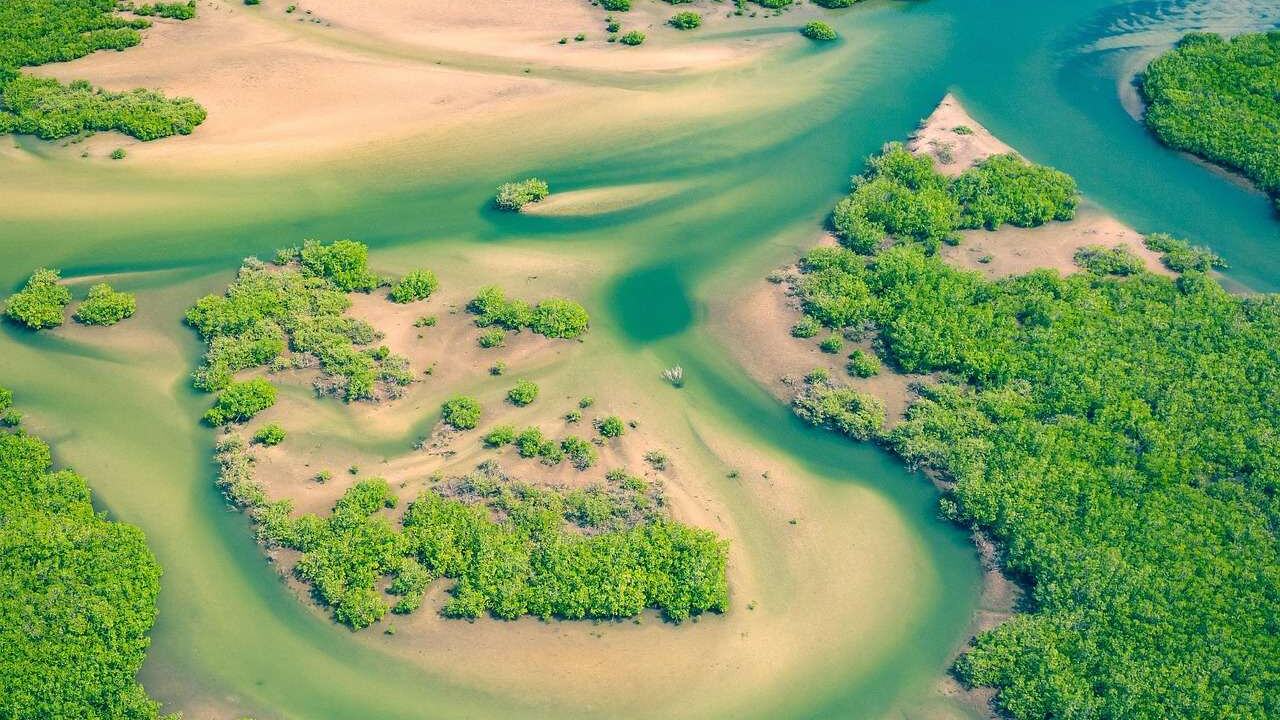
Wondering whether coastal wetlands really matter for climate? Blue carbon is the carbon captured and stored by coastal ecosystems such as mangroves, salt marshes and seagrass, and their soils can hold it for centuries.
This guide sits within the wider topic of ocean climate solutions, which looks at the different ways the ocean may help with climate change.
| Item | Value |
|---|---|
| Carbon uptake of mangroves and coastal wetlands versus mature tropical forests | Ten times greater per year |
| Carbon stored per equivalent area versus tropical forests | Three to five times more |
| How long carbon can persist in coastal wetland soils | Hundreds or even thousands of years |
| Share of pre-industrial coastal wetland extent lost since the 19th century | Nearly half |
| Year the blue carbon concept appeared in a United Nations assessment report | 2009 |
These figures come from the NOAA Ocean Service and the Coastal Wiki. They can change as new research appears, so check the sources before you rely on them.
What counts as blue carbon
NOAA describes coastal blue carbon as the carbon captured by living coastal and marine organisms and stored in coastal ecosystems, as set out on its Ocean Service page. The term is young: the concept was introduced in 2009 in a United Nations assessment report, according to the Coastal Wiki.
The same wiki says an ecosystem should meet three criteria to be considered blue carbon. It should:
- have a significant scale of greenhouse gas emissions or removals;
- support long-term storage of carbon, on timescales beyond centuries;
- be amenable to management actions that enhance carbon storage or avoid greenhouse gas emissions.
The ecosystems usually counted are salt marshes, mangroves and seagrass meadows. Seagrass alone is substantial: Nature’s blue carbon collection lists work reporting that seagrass meadows store 24-40 million tons of carbon and fix 83-137 million tons of carbon annually in their biomass.
How coastal wetlands lock carbon away
Coastal wetlands are very productive, meaning the plants grow a lot each year and take in large amounts of carbon dioxide as they do. NOAA separates two roles: carbon sequestration, the capture of carbon dioxide measured as an uptake rate per year, and carbon storage, the long-term confinement of carbon measured as a total weight.
The second half of the story is the soil. In most coastal wetlands only a thin top layer is oxygenated, while the rest sits under water, and oxygen diffuses very slowly through water. With little to no oxygen, organic material breaks down slowly, so NOAA says the carbon can persist for hundreds or even thousands of years.
NOAA describes the path of carbon through a wetland in these steps:
- Plants take in carbon dioxide from the air through photosynthesis.
- Dead leaves, branches and roots are buried in soil that is frequently, if not always, covered with tidal waters.
- The oxygen-poor conditions slow decomposition, so much of that carbon stays locked in the soil.
- A small amount of carbon is lost back to the atmosphere through respiration.
This is why wetlands count as good carbon sinks, meaning they store a lot of carbon. Most of it sits in the soil rather than in above-ground plant material, which is a key difference from tropical forests.
How does blue carbon compare with forests?
NOAA reports that current studies suggest mangroves and coastal wetlands sequester carbon at a rate ten times greater each year than mature tropical forests. They also store three to five times more carbon per equivalent area, according to the NOAA Ocean Service.
Their small footprint makes this more striking. A 2011 review in Frontiers in Ecology and the Environment, hosted by Conservation Gateway, notes that the global area of these habitats is one to two orders of magnitude smaller than that of terrestrial forests. Their contribution per unit area to long-term carbon sequestration is nonetheless much greater.
The same review links part of this to the way the habitats trap suspended matter and associated organic carbon during tidal inundation. These are per-area comparisons, so they say nothing about total scale, which the section on limits returns to.
Why losing coastal wetlands hurts
When coastal habitats are damaged or destroyed, stored carbon can be released as well as the capacity to capture more. NOAA says this adds to greenhouse gas levels in the atmosphere, and that habitats are being lost at a rapid rate, largely because of coastal development for housing, ports and commercial facilities (NOAA Ocean Service).
The Coastal Wiki adds that nearly half of the pre-industrial, natural extent of global coastal wetlands has been lost since the 19th century.
Restoration has not yet closed the gap. A study from April 2026 in Nature’s blue carbon collection reports that global salt marshes are losing soil carbon faster than restoration can recover it, with persistent degradation hotspots in North America.
The review hosted by Conservation Gateway argues that recognising the carbon value of these ecosystems gives a strong argument for their protection and restoration. As of the Nature collection’s 11 April 2024 description, some countries have included conservation and restoration of coastal ecosystems in their climate mitigation strategies (Nature).
Carbon is not the only reason to keep these habitats intact. The Coastal Wiki lists several other benefits:
- They help protect the coast against erosion and flooding.
- They provide spawning, breeding and nursery grounds for fish and birds.
- They help break down polluting and eutrophying substances.
Limits and open questions
Blue carbon is not a cure-all. A comment in Communications Earth & Environment, listed in Nature’s blue carbon collection, argues that blue carbon will not solve climate change because the effect is too small, existing sediment carbon stock is a liability, and there is a timescale mismatch between ancient fossil fuel emissions and uptake by vegetation.
Not every coastal habitat is a sink. The Coastal Wiki says calcification releases carbon dioxide, so habitats such as coral reefs and oyster reefs are likely to be net sources rather than sinks, even though they help with coastal adaptation.
Seaweed is the most debated edge of the field. The Coastal Wiki says blue carbon did not originally include macroalgal ecosystems, but evidence is mounting that they contribute substantially to marine carbon sequestration. It also says macroalgal carbon export and deliberate seaweed sinking remain more uncertain for certifiable climate mitigation.
A Nova Scotia study in the Nature collection found that kelp forests sequester more carbon than eelgrass beds by about 1.3 orders of magnitude, mainly through release and export of dissolved organic carbon. The guide to seaweed farming carbon sequestration covers the separate questions raised by farmed seaweed.
Accounting is the other hard part. The Coastal Wiki stresses that carbon fixation by photosynthesis should not be equated with sequestration, because the relevant quantity is additional, durable and verifiable net removal after subtracting:
- respiration and remineralisation;
- methane and nitrous oxide emissions;
- leakage;
- management-related emissions.
Coastal habitats are only part of the ocean toolbox, and approaches such as artificial upwelling are treated as a separate topic on this site.
Frequently asked questions
What is blue carbon in simple terms?
Show answer
It is the carbon captured by living coastal and marine organisms and stored in coastal ecosystems, according to NOAA. Salt marshes, mangroves and seagrass meadows are the usual examples.
Why do wet coastal soils store so much carbon?
Show answer
Water-logged soils contain little to no oxygen, so plant material decomposes slowly. The carbon stays buried instead of returning to the air.
Are coral reefs blue carbon ecosystems?
Show answer
Not in the usual sense. The Coastal Wiki says calcifying habitats such as coral reefs and oyster reefs help with climate adaptation but are likely to be net carbon dioxide sources rather than sinks.
Can blue carbon offset fossil fuel emissions?
Show answer
The authors of a comment listed in Nature’s collection argue it cannot truly do so, because the effect is too small. Protecting these habitats still avoids releasing carbon that is already stored.