Wondering how much carbon mangroves really hold? Mangrove carbon storage is large: a 25-site Indo-Pacific study found an average of 1,023 Mg carbon per hectare, much of it in the soil.
This page is part of a wider look at ocean climate solutions, and it focuses on what one landmark study measured.
| Item | Value |
|---|---|
| Average whole-ecosystem carbon storage | 1,023 Mg carbon per hectare |
| Share of carbon held in organic-rich soils | 49-98% |
| Depth of organic-rich soils | 0.5 m to more than 3 m |
| Estimated emissions from mangrove deforestation | 0.02-0.12 Pg carbon per year |
| Mangrove share of tropical forest area | 0.7% |
| Decline in mangrove areal extent over the past half century | 30-50% |
These figures come from Donato et al., Nature Geoscience (April 2011). Estimates like these can change as new data arrive, so check the source before you rely on them.
What the main study measured
Much of the discussion about mangroves and climate leans on one Nature Geoscience letter by Donato and colleagues, published in April 2011. The team measured carbon across 25 mangrove forests in the Indo-Pacific region, which spans 30° of latitude and 73° of longitude, according to the paper’s abstract.
The region was chosen because it is where mangrove area and diversity are greatest. At each site the researchers measured three things:
- Tree and dead wood biomass
- Soil carbon content
- Soil depth
Together these let them estimate whole-ecosystem carbon storage, meaning the carbon in living wood, dead wood and the soil beneath, rather than only the trees you can see.
How much carbon do mangroves hold?
The headline result is that mangroves are among the most carbon-rich forests in the tropics. Across the sampled sites, the paper reports an average of 1,023 Mg carbon per hectare, as stated in the Nature Geoscience abstract.
The authors compare this with the storage of major global forest domains, which is how they reach the “carbon-rich” conclusion. The full comparison sits behind a subscription, so this page sticks to the figures in the abstract.
Mangroves also do other work. The abstract notes that mangrove forests support ecosystem services such as fisheries production and nutrient cycling, so carbon is one benefit among several.
Why the soil matters most
The surprise for many readers is where the carbon sits. Organic-rich soils in the study ranged from 0.5 m to more than 3 m in depth and accounted for 49-98% of carbon storage, per the same paper.
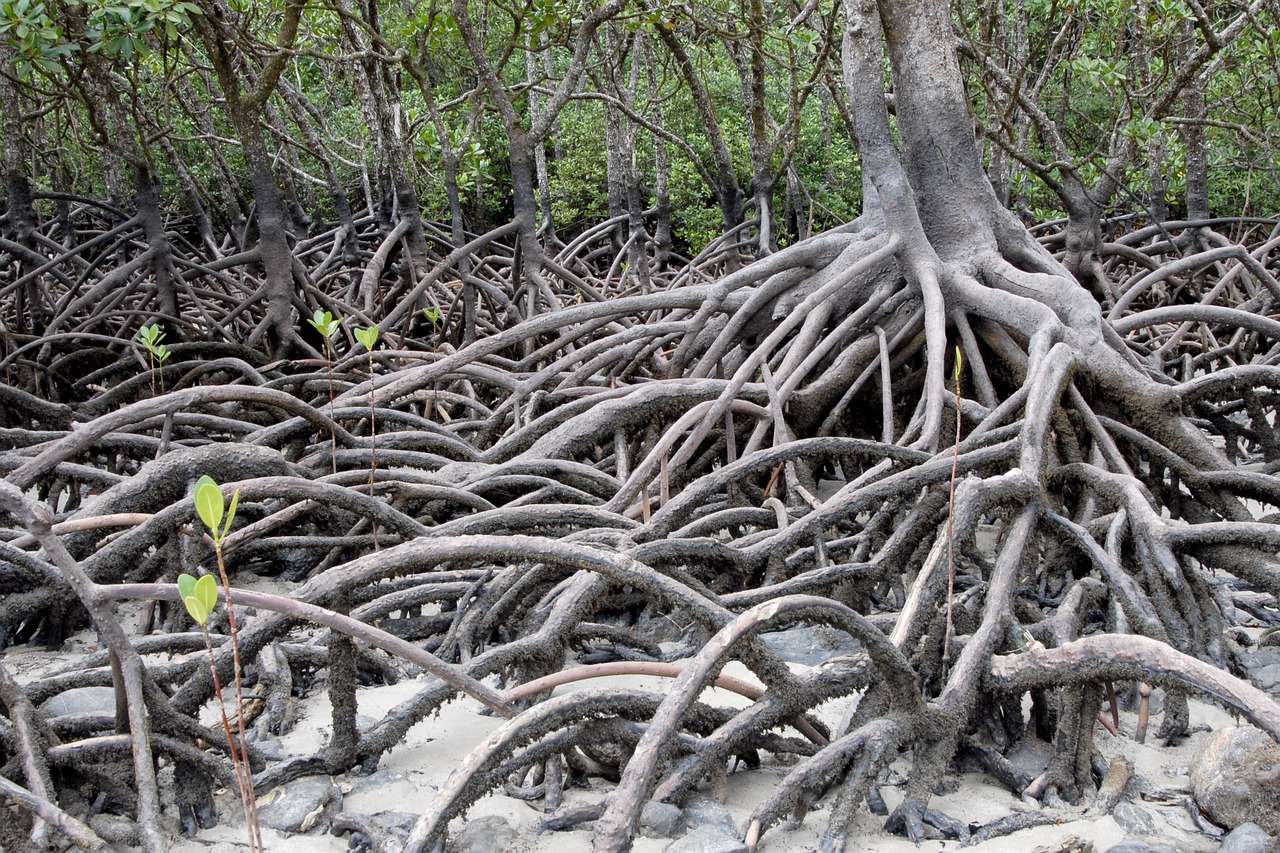
In other words, a mangrove is not just a stand of trees. In many of the sites, the soil carbon pool is the larger part of the store, and it is the part that a satellite image of the canopy cannot show.
The authors also say that carbon emissions from mangrove loss have been uncertain, partly because broad-scale data on carbon stored below ground were lacking. Measuring soil depth and soil carbon directly was their way of filling that gap.
What happens when mangroves are lost?
Mangroves have been shrinking. The abstract says their areal extent declined by 30-50% over the past half century, a drop attributed to three pressures, as reported by Donato et al.:
- Coastal development
- Aquaculture expansion
- Over-harvesting
Because so much carbon sits in the soil, clearing a mangrove forest can release more than the wood alone would suggest. The authors estimate that mangrove deforestation generates emissions of 0.02-0.12 Pg carbon per year, as reported in the paper.
That is as much as around 10% of emissions from deforestation globally, even though mangroves account for just 0.7% of tropical forest area. The disproportion is the main reason mangroves keep appearing in climate discussions.
How to read these numbers with care
A single average can hide a lot. The same study found soil depths from 0.5 m to more than 3 m and soil shares from 49-98% of storage, so an individual forest can sit well away from the 1,023 Mg per hectare mean.
Keep these limits in mind when you use the figures:
- Region: the sites are in the Indo-Pacific, so the average is not a global measurement for every mangrove coast.
- Age: the paper was published in April 2011, and later studies may refine or revise its estimates.
- Range, not a point: the emissions estimate is a span of 0.02-0.12 Pg carbon per year, which signals real uncertainty.
- Stocks versus removal: the study measures carbon already stored, not how quickly a new forest would take up more.
The last point is easy to miss. A large store is a reason to protect existing forest, but it does not by itself tell you how much carbon a restoration project would remove.
The deforestation estimate deserves extra caution. The authors say they combined their own measurements with other published information, so it is a derived estimate rather than a direct count of emissions at cleared sites, as stated in the abstract. The phrase “as much as around 10%” also marks the upper end of the claim, not a typical value.
The paper itself points to the soil as the place where site-to-site differences arise. One of its figures is titled “Soil properties determining below-ground carbon storage in Indo-Pacific mangroves”, which fits the wide spread in soil depth and carbon share described above.
When you meet a mangrove carbon number somewhere else, it helps to ask four questions before you compare it with the figures here:
- Does it count only trees, or the soil as well?
- Which region and how many sites does it come from?
- Is it a stored amount, or an amount taken up or released each year?
- Is it an average, or a range with a stated low and high end?
A number that cannot answer these questions is hard to line up against the study’s whole-ecosystem measurements, and you should treat any comparison as rough.
Where mangrove carbon fits among ocean approaches
Mangroves are coastal ecosystems that hold carbon in living wood and soil. That makes them a different kind of question from engineered options such as direct ocean capture, which is covered on its own page.
If you want the wider picture of how seawater and marine systems might be used to take carbon out of the air, the page on marine carbon dioxide removal gives that overview. This site is independent and educational, so it does not sell services or take enquiries.
Frequently asked questions
How much carbon do mangroves store?
Show answer
In the 25 Indo-Pacific forests studied, the average was 1,023 Mg carbon per hectare, according to Donato et al. (April 2011). Individual forests vary around that figure.
Where is most of the carbon stored?
Show answer
Mostly below ground. Organic-rich soils accounted for 49-98% of carbon storage in the study, according to the paper.
Why does losing mangroves matter for the climate?
Show answer
The authors estimate emissions of 0.02-0.12 Pg carbon per year from mangrove deforestation, as much as around 10% of global deforestation emissions, from forests with just 0.7% of tropical forest area, per the same source.
Do these figures apply to every mangrove forest?
Show answer
No. The study sampled 25 forests in the Indo-Pacific, and soil depth and carbon share varied widely between them. Treat the average as a guide, not a measurement for any single site.