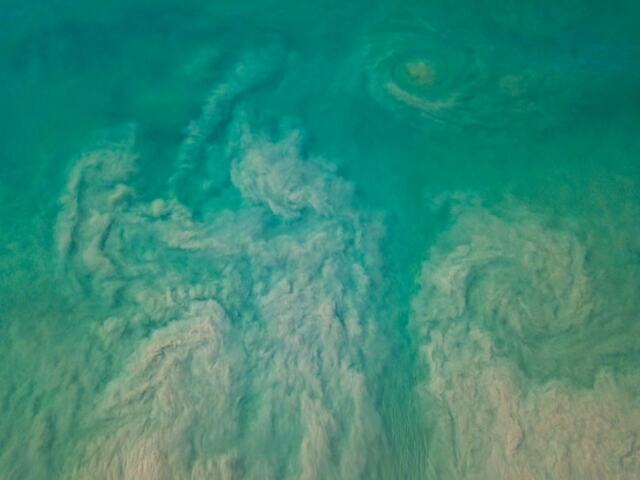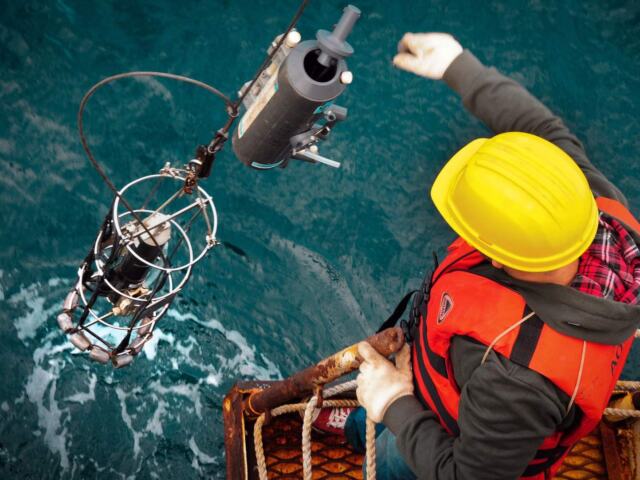
If you’ve heard the ocean has a “conveyor belt” and wondered how it works, here’s the short version. Thermohaline circulation is a slow, global flow driven by temperature and salt, taking an estimated 1,000 years per loop.
This guide sits inside the marine science section of the site and covers the physics, the Atlantic branch and the open questions.
| Item | Value |
|---|---|
| Time for a parcel of water to complete the global belt | An estimated 1,000 years |
| Possible AMOC weakening over the past 50 years | Around 15% |
| AMOC average strength, 1995-2014 | Around 20 Sv |
| One sverdrup (Sv) | 1 million cubic metres per second |
| Length of direct AMOC measurement (as of the 2023 explainer) | About 20 years |
These figures come from the NOAA National Ocean Service AMOC page and the climatetippingpoints.info explainer of August 15, 2023. Estimates can change as new research appears, so check the sources before you rely on them.
How thermohaline circulation works
NOAA describes thermohaline circulation as a set of much slower currents, reaching from the surface to the seafloor, that are driven by changes in saltiness and ocean temperature. Those two drivers set the density of the water, and density decides whether it floats or sinks.
It helps to separate it from the other currents you may know, as the NOAA explainer does:
- Tidal currents occur close to shore and are influenced by the sun and moon.
- Surface currents are influenced by the wind.
- Thermohaline currents run from the surface to the seafloor and respond to temperature and salinity.
NOAA groups these deep, slow currents into a “global conveyor belt”. The Atlantic part of that belt is the AMOC, covered below.
Why does water sink in the North Atlantic?
The sinking is the engine of the whole system. The steps below combine the NOAA description with the climatetippingpoints.info explainer.
- Warm water near the surface moves toward the poles, for example along the Gulf Stream in the North Atlantic.
- On the way it cools, and it gets saltier through evaporation. Where sea ice forms, salt is left behind in the water.
- The cold, salty water becomes dense enough to sink, then flows south along the Atlantic Ocean floor.
- It eventually re-emerges at the surface in the Southern, Indian or Pacific Oceans, a process called upwelling, which completes the cycle.
The whole loop is slow. NOAA gives an estimated 1,000 years for a given cubic metre of water to travel the full belt.
The AMOC: the Atlantic leg of the conveyor
AMOC stands for Atlantic Meridional Overturning Circulation. NOAA describes it as a system of currents that circulates water within the Atlantic, bringing warm water north and cold water south.
The name reflects what it does: it “overturns” the ocean through deep mixing, and it transports water across latitudes, according to climatetippingpoints.info. That makes it a key part of the global thermohaline circulation.
Don’t confuse it with the Gulf Stream. The same explainer describes the Gulf Stream as a strong current of warm water driven by winds and the Earth’s rotation. Without it and the North Atlantic Current it feeds, Northern Europe would be as cold as Newfoundland and Labrador in Canada, and Spain as cold as New York.
Is the conveyor belt slowing down?
NOAA says research shows the AMOC has been weakening over the past century. Whether it will keep slowing, or stop circulating completely, remains uncertain.
The climatetippingpoints.info explainer reports some evidence that the AMOC may have weakened by around 15% over the past 50 years. Direct measurements cover only about 20 years, so earlier changes rely on more uncertain reconstructions of past climate.
The IPCC’s wording has shifted with the evidence. In 2013 it stated there was no observational evidence of a trend, and later reports say the AMOC has weakened relative to 1850-1900, but with only low confidence because reconstructions and models disagree.
Why warming weakens the sinking
Global warming works against the density difference that drives the sinking. The same explainer lists the main changes in the key mixing region:
- Warmer surface water.
- Increased rainfall.
- More freshwater run-off from Greenland.
- Reduced sea ice formation.
Each of these tends to make surface water less dense, which interferes with sinking and reduces deep convection.
The “cold blob” clue
One suggested sign of weakening is the cold blob, a part of the North Atlantic that has cooled while the globe warmed. One explanation is that a weaker AMOC carries less heat north. The same source cautions that local atmospheric effects could also be involved, so the cause is not certain.
What could a weaker or collapsed AMOC mean?
As Al Jazeera reported in November 2021, the IPCC report it covered found with high confidence that the AMOC will likely weaken in the coming decades, but a total collapse before 2100 is unlikely. That is the status of that 2021 reporting, and later research may refine it.
Scientists still debate whether the decline will stay gradual or hit a tipping point. The same article says discrepancies between observed data and models remain, with no consensus on how long a full shutdown could take. Some estimates suggest as long as several hundred years.
Past behaviour shows the system can change state. Al Jazeera notes the last shutdown came toward the end of the last ice age, about 14,500 years ago, when glacial melt flooded the North Atlantic with fresh water. The climatetippingpoints.info explainer adds that geological records suggest the AMOC has abruptly switched between stronger and weaker modes during recent glacial cycles.
The impacts cited in the sources include:
- Temperatures in Europe and eastern North America dropping by as much as 5 °C (9 °F) if the circulation collapsed, per Al Jazeera.
- Sea level rise across the U.S. East Coast if the AMOC keeps slowing, per NOAA.
- A shifted rain belt in South Africa, causing droughts for millions of people, if the planet keeps warming, per NOAA.
- Disruption to the West African and Asian monsoons, per Al Jazeera.
Niklas Boers of the Potsdam Institute for Climate Impact Research told Al Jazeera that the amount of greenhouse gas released is the most important factor. His advice was to reduce emissions as much and as fast as possible.
Why the circulation matters beyond the Atlantic
NOAA says the circulation brings warmth to various parts of the globe and carries nutrients needed to sustain ocean life. Both roles tie it to wider ocean questions.
To see how the ocean’s stored warmth is tracked, read about ocean heat content. For the biological side, the role of phytoplankton in climate shows why nutrient supply matters.
Frequently asked questions
What is thermohaline circulation in simple terms?
Show answer
It is the slow movement of ocean water from the surface to the seafloor and back, driven by differences in temperature and saltiness, according to NOAA.
How long does one trip around the conveyor belt take?
Show answer
NOAA gives an estimated 1,000 years for any given cubic metre of water to complete the journey along the belt.
Is the AMOC the same as the Gulf Stream?
Show answer
No. The Gulf Stream is a wind- and rotation-driven warm current, while the AMOC is the Atlantic overturning system that includes deep sinking and southward flow, per climatetippingpoints.info.
Will the AMOC collapse?
Show answer
It is uncertain. As Al Jazeera reported in November 2021, the IPCC report it covered judged a total collapse before 2100 unlikely, while NOAA says it remains uncertain whether the weakening will continue or stop the circulation completely.