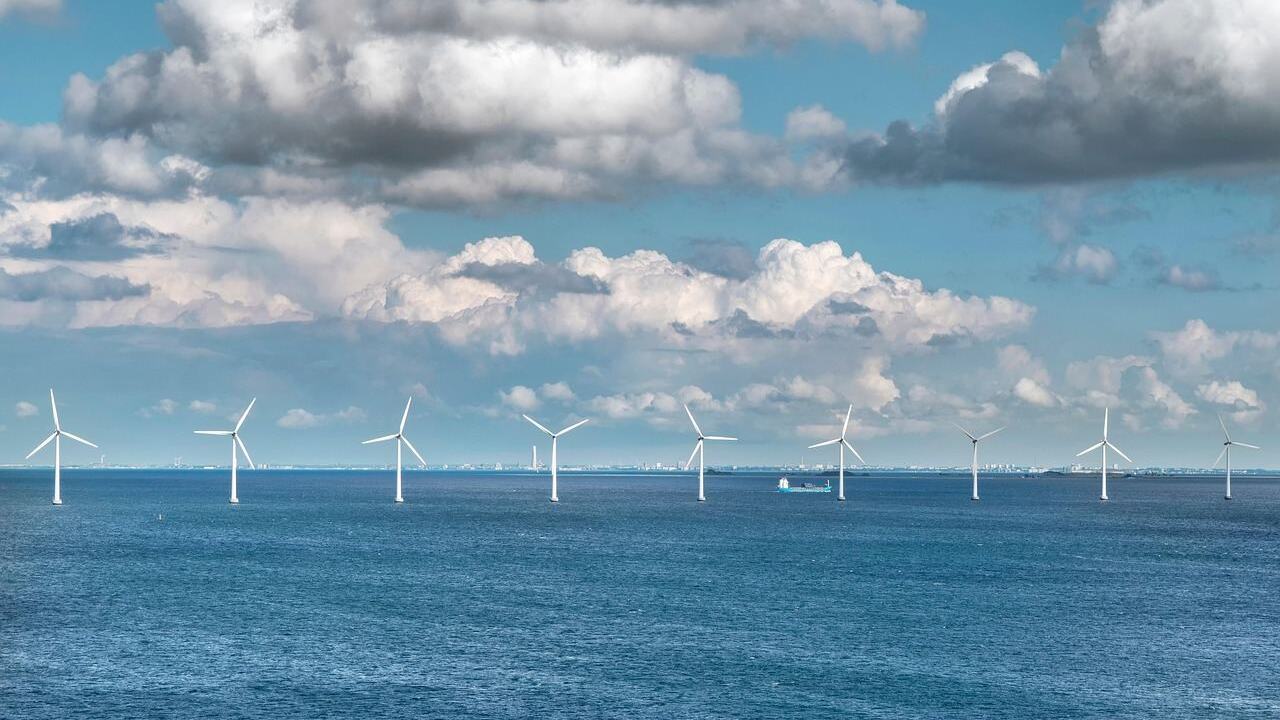
You may be asking: how does offshore wind work? Wind spins blades, a generator in the nacelle turns that motion into electricity, and cables carry it to shore and the grid. The details are simpler than they look.
This guide is part of our wider look at ocean renewable energy, which compares the main ways the sea can help power the grid.
| Item | Value |
|---|---|
| Typical output of a modern offshore turbine | 12 to 15 MW |
| Larger turbine model under commercial development | 18 MW |
| Offshore substations on a large wind farm | Two or more |
| Thickness of a traditional AC export cable | Often nearly a foot in diameter |
| Sections in a typical turbine tower | Three steel tubes |
These figures come from the Clean Energy States Alliance, in its Building the Foundation series. They can change as turbines and projects develop, so check the source before you rely on them.
From moving air to electric current
An offshore wind farm turns kinetic wind energy into mechanical energy, and then into electric energy, as Offshore Wind Maryland explains. Blowing wind turns turbine blades connected to a rotor, and the rotor drives a drivetrain or gearbox to generate electricity.
Inside the nacelle, the generator does the conversion. According to the Clean Energy States Alliance, the spinning rotor turns gears in the nacelle, and the gears turn a powerful set of magnets to generate an electrical current.
The electricity then follows a fixed route to your home or workplace:
- Wind turns the blades and rotor, and the generator produces electricity.
- Inter-array cables carry the power from each turbine to an offshore substation.
- The substation raises the voltage so less energy is lost on the way to shore.
- One or more export cables carry the power to an onshore substation.
- The onshore substation connects and synchronizes the power to the grid.
Wind is one way to draw energy from the sea, and tidal power is another. If you want to compare two tidal designs, see our explainer on tidal stream vs tidal barrage.
What are the main parts of an offshore wind turbine?
Offshore Wind Maryland describes the wind turbine generator as a rotor (blades and hub), a nacelle that houses the generating components, a tower, and a transition piece that connects the tower to the foundation. Each part has a distinct job.
- Foundation: an enormous steel or concrete structure that anchors the turbine to the sea floor.
- Transition piece: a large steel tube that joins the foundation to the tower and gives technicians a platform to get onto the structure.
- Tower: the tall steel tube that gives the turbine its height.
- Nacelle: the housing at the top of the tower that converts the rotation of the blades into electrical power.
- Blades: the most recognizable part, which spin as wind flows across their surface.
Towers are often taller than the Statue of Liberty, according to the Clean Energy States Alliance. A tower that tall is hard to transport in one piece, so it is typically built from three steel tubes joined together onshore.
Blades are made of carbon fiber or other plastic-composite materials, and each one is typically longer than a football field. Unlike towers, blades cannot be assembled in pieces, which makes moving them a delicate and expensive part of the job.
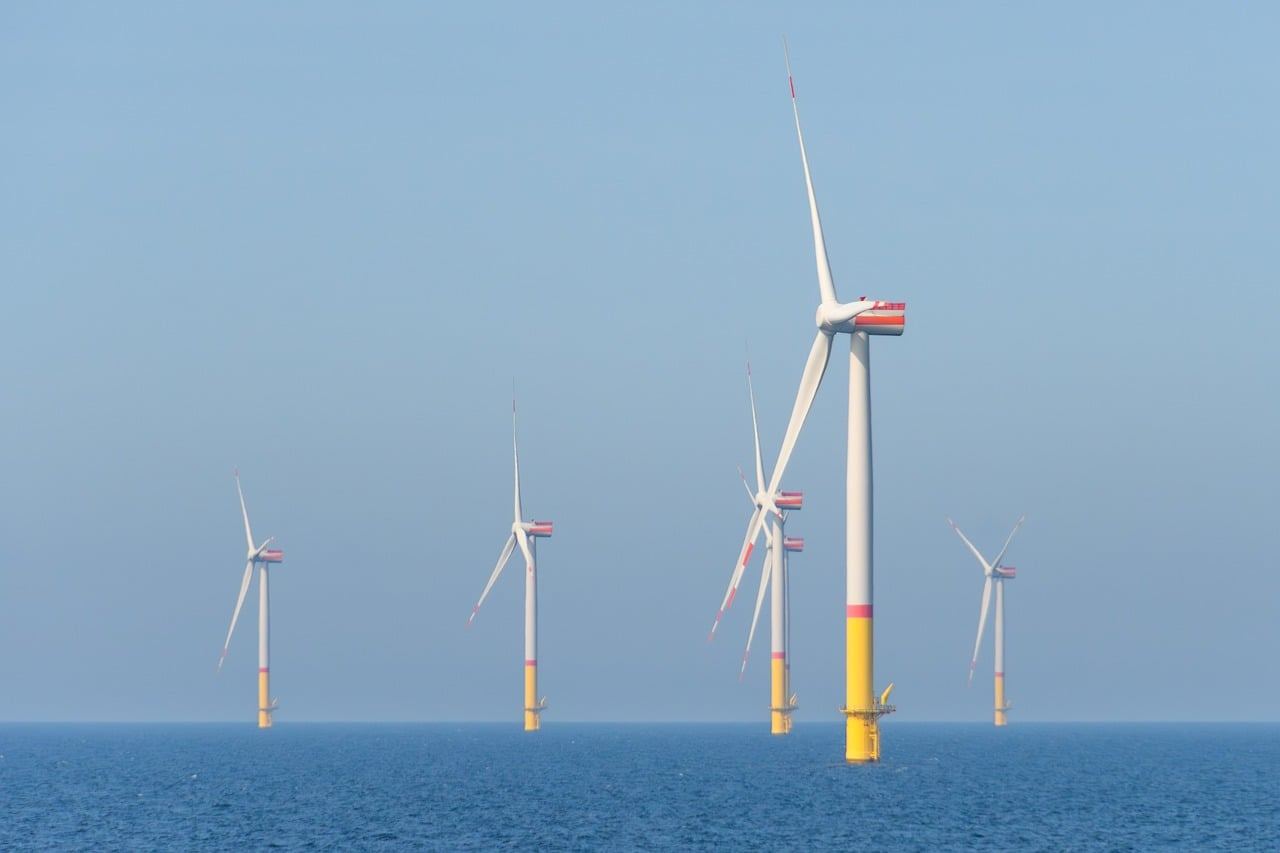
How the power travels from turbine to grid
Each turbine feeds an inter-array cable, which delivers power to a central offshore substation or to several. These cables are buried under the seafloor. A large wind farm typically has two or more offshore substations.
The substation collects the power and transforms it to a higher voltage before sending it to shore through an export cable, Ørsted explains. Transmitting at a higher voltage means less energy is lost over long distances.
Many newer offshore substations also convert the power from alternating current (AC) to direct current (DC). This HVDC approach lets power travel longer distances with fewer losses, and the Clean Energy States Alliance notes that recent wind farms have started to use high-voltage DC cables.
A traditional AC export cable is very thick, often nearly a foot in diameter, and is buried under the seafloor. Newer HVDC export cables are thinner because they need only one wire, instead of the three that AC cables require.
At the onshore substation, the power is adjusted in voltage and frequency so that it can be used on the grid. If the project uses HVDC export cables, this substation also converts the power back to AC.
Foundations: fixed to the seabed or floating
The type of foundation depends on the depth of the water and the composition of the seafloor, according to the Clean Energy States Alliance. Fixed-bottom turbines typically use one of three designs.
- Monopiles: large steel tubes hammered into the seafloor with a piledriver.
- Gravity foundations: wide, heavy concrete bases that typically use suction to stay in place.
- Jackets: three- or four-legged steel structures that also typically use suction.
Ørsted describes fixed-bottom monopile foundations as suitable for shallow water. In deeper water, a turbine can sit on a floating foundation instead, which is moored in place.
Floating foundation technology is less standardized, and designs are often ballasted concrete tubes or very wide concrete platforms. They usually use one or a series of heavy lines moored to the seafloor, and our guide to floating offshore wind turbines covers them in more depth.
How a wind farm is built at sea
Foundations are always the first structures installed at a wind farm, and transition pieces are the second. After that, installation vessels bring the remaining components out to sea in pieces to be assembled on site. Once in position, the vessel lowers its four legs onto the seabed to stabilize itself.
Ørsted describes the order of work for the turbine itself:
- A crane places the steel turbine tower onto the foundation.
- The nacelle and rotor are installed on top of the tower.
- The blades are lifted and bolted to the rotor one by one.
The offshore substation has two parts, a foundation and a topside. The foundation is installed like a turbine foundation, while the topside is built and tested onshore and then shipped out. A cable laying vessel places the cables on the seabed and connects them to each turbine via the foundations.
Driving a monopile into the seabed with a hydraulic hammer emits sound underwater. Ørsted says it uses noise reduction such as double bubble curtains, which put a circular curtain of bubbles around the monopile to dampen the sound pressure waves.
Its wider protective measures include restricting vessel speed, mandatory observers onboard vessels, construction clearance zones, additional lookout vessels, and underwater acoustic monitoring. These are one developer’s practices, not a rule for every project.
Frequently asked questions
How much power does one offshore turbine make?
Show answer
As of the Clean Energy States Alliance’s August 2025 newsletter, modern turbines typically generate between 12 and 15 MW. Models of 18 MW were under commercial development, and researchers were testing models that could generate more than 20 MW.
Why do offshore substations raise the voltage?
Show answer
Transporting power at a higher voltage decreases the amount of power lost on its way to shore. That matters because the export cable may have to cover a long distance.
What is the difference between AC and HVDC export cables?
Show answer
HVDC cables can transfer more power with fewer losses than traditional AC cables. They also need only one wire instead of three, so they are thinner, but the onshore substation must convert the power back to AC for the grid.
Do all offshore turbines stand on the seabed?
Show answer
No. Fixed-bottom turbines use monopiles, gravity foundations or jackets, while floating turbines sit on foundations moored to the seafloor. The choice depends on water depth and seafloor conditions.