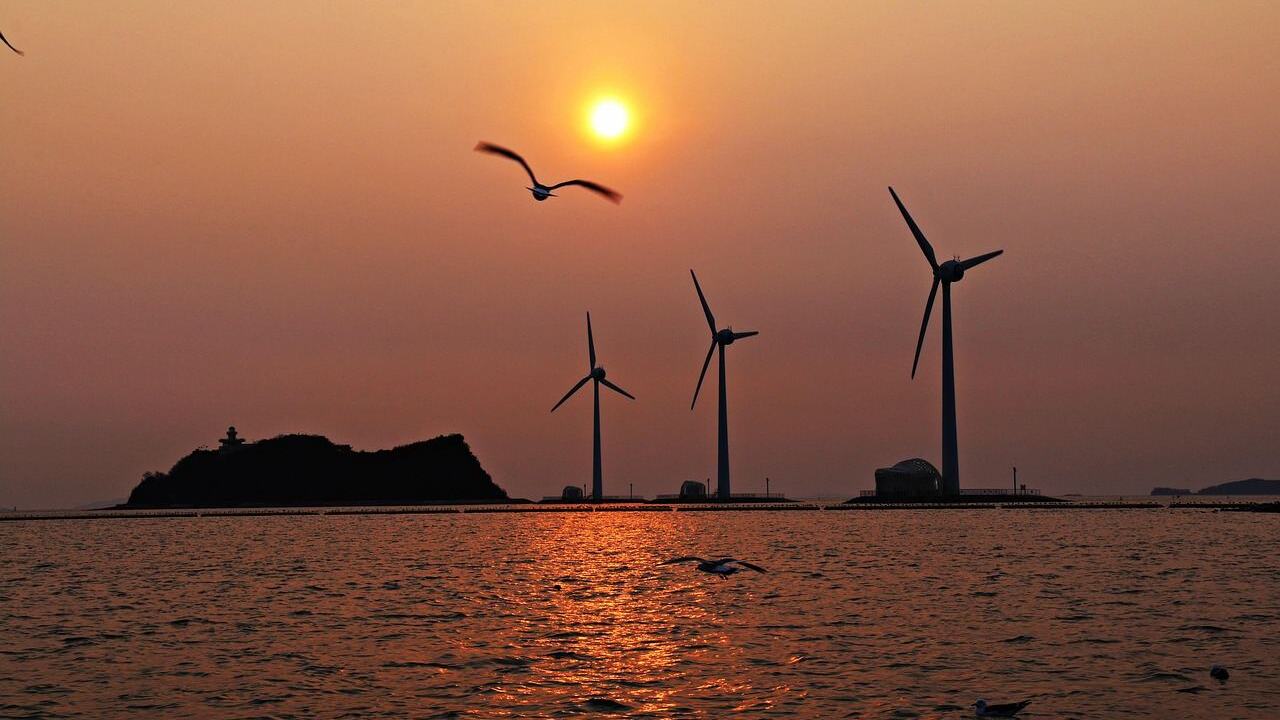
Worried about what turbines do to whales, fish and the seabed? The offshore wind environmental impact is mainly a construction-noise issue, while buried cables and running turbines show smaller effects in federal reviews.
Offshore wind sits within the wider field of ocean renewable energy, and this guide looks at what studies say about its effects on marine life.
| Item | Value |
|---|---|
| Standard burial depth for submarine cables | 3-10 ft, in waters shallower than 6,562 ft (2000 m) |
| Deepest cable burial cited for local hazards | Up to 32 ft under the seabed |
| Sediment heating next to a buried cable | 10 to 20°C above ambient, within 1.3 to 2 ft of the cable |
| Hearing range of fish and invertebrates | Generally under 1 kHz |
| Safety zone used during Block Island Wind Farm construction | 500 yards around turbine locations |
These figures come from the Bureau of Ocean Energy Management (BOEM) fishing and offshore renewable energy FAQ. Figures can change as new research and project decisions arrive, so check the source before you rely on them.
Do offshore wind farms harm whales and other marine mammals?
A common question is whether noise from underwater surveys and service vessels confuses whales and leads them to strand on beaches. The U.S. Department of Energy’s WINDExchange page says there is no evidence for whale strandings being caused by noise from offshore wind energy development, according to BOEM and NOAA. You can read that statement on the DOE WINDExchange marine mammals page.
The same page names the greatest human threats to large whales in the United States: vessel strikes and entanglement in fishing gear. That puts wind-farm noise in context, although it does not make the question go away.
DOE also notes that offshore wind expansion raises concerns about several groups of wildlife:
- Fish
- Invertebrates
- Birds
- Bats
- Marine mammals
If you want to check strandings yourself, the DOE page points to NOAA’s interactive map of 2016-2023 humpback whale strandings. It is a useful way to see where events were recorded without relying on a summary.
Underwater noise: fish, invertebrates and construction
BOEM separates wind-farm sound by project stage, because each stage sounds different. Most of the sound sources used in high-resolution geophysical surveys are out of the hearing range of fish and invertebrates, according to BOEM’s FAQ.
The loudest stage is pile-driving. BOEM says the sounds from percussive pile-driving are high intensity, and some of that acoustic energy overlaps with the hearing range of fishes and invertebrates, which is generally under 1 kHz.
Operation is different. BOEM says low-level continuous noise from operating turbines is very quiet, generally quieter than natural wind-generated ocean noise, and unlikely to affect marine life.
- Surveys: most sources fall outside the hearing range of fish and invertebrates.
- Pile-driving: high intensity, with overlap into the hearing range of fish and invertebrates.
- Operation: low-level continuous noise that BOEM describes as generally quieter than natural wind-generated ocean noise.
For marine mammals, DOE says federal agencies and partners are advancing technologies that minimize turbine installation noise. That makes construction the stage to watch most closely.
Cables, electromagnetic fields and heat
Turbines themselves do not generate electromagnetic fields (EMF). According to BOEM, once a cable is energized it will produce a magnetic field, which is why cable design and burial matter.
BOEM says cables will be buried beneath the seafloor and wrapped in a sheath that eliminates direct electric fields and reduces magnetic and induced electric fields. The EMF decays quickly with distance from the cable, and burial helps minimize exposure.
Some animals do react. BOEM’s summary of current research is that species such as skates, sharks and lobster are sensitive to EMF, but detrimental effects to populations are not expected, and the fields do not act as a barrier to movement.
Heat is the other cable question. BOEM says a buried cable would generate enough heat to raise surrounding sediment temperatures by as much as 10 to 20°C above ambient within 1.3 to 2 ft of the cable, though typical burial depths limit exposure to that heating.
BOEM describes how cables are protected on the seabed:
- Standard commercial practice is to bury submarine cables 3-10 ft deep in waters shallower than 6,562 ft (2000 m).
- Cables may be buried as deep as 32 ft to mitigate local hazards, depending on water depth and bottom type.
- Other measures include protective covering such as concrete mattresses, which are concrete block sections connected by metal braided cables.
Seabed, habitat and fishing: what monitoring tracks
BOEM’s list of Rhode Island studies shows how much of this question is being measured on real projects. Its titles include benthic and epifaunal monitoring at the Block Island Wind Farm, seafloor disturbance and recovery monitoring (including a Year 6 summary report), and observations of cable laying and particle settlement during construction.
Other listed work covers lobsters and crabs in the Rhode Island and Massachusetts wind energy area, and EMF effects on elasmobranchs and American lobster from direct current cables. This page does not summarize those reports, so open the BOEM list if you need their findings.
Birds are part of the research too. BOEM’s Maryland studies page lists a satellite telemetry project on fine-scale use and movement patterns of diving bird species in federal waters of the Mid-Atlantic.
On fishing access, BOEM says it does not have the authority to restrict vessel traffic in and around offshore wind facilities. The U.S. Coast Guard has said safety zones and buffers would be evaluated case by case, and it implemented a 500-yard safety zone around turbine locations during Block Island Wind Farm construction.
How are the impacts reduced?
BOEM analyzes proposed activities, including offshore wind, for potential impacts to marine species and habitats, multiple-use conflicts and access to resources. Its assessments include National Environmental Policy Act (NEPA) reviews at various stages of development and consultation with federal agencies and tribal governments.
BOEM describes its method in broad steps:
- Gather the best-available science from publicly available peer-reviewed publications and state and federal government reports.
- Identify the types of activities that could affect species and physical resources.
- Evaluate the potential for impacts.
- Consider the range of mitigations that could reduce or avoid those impacts.
BOEM also funds its own research, including studies on the effects of EMF and underwater sound and on impacts to commercial and recreational fisheries. DOE adds that federal agencies and partners are working on technologies to better detect when whales are in the area, so crews can pause construction activities.
What is still being studied
Several larger research efforts look past single projects. BOEM’s study lists include Wildlife and Offshore Wind (WOW), a systems approach to research and risk assessment from Maine to North Carolina, and a project on offshore wind impacts on oceanographic processes from North Carolina to New York.
The National Academies of Sciences, Engineering, and Medicine also published a 2024 report, Potential Hydrodynamic Impacts of Offshore Wind Energy on Nantucket Shoals Regional Ecology, subtitled “An Evaluation from Wind to Whales”. The National Academies reference chapter lists the research behind it, including a generalized impact assessment of wind-farm effects on marine wildlife.
If you are comparing ocean energy options, the guides on salinity gradient power and renewable energy for desalination cover related topics.
Frequently asked questions
Do offshore wind turbines cause whale strandings?
Show answer
BOEM and NOAA, as relayed by DOE, have found no evidence linking wind-farm noise to strandings. The larger human threats to large whales in U.S. waters are ship collisions and getting caught in fishing gear.
Are offshore wind cables harmful to fish?
Show answer
BOEM says species such as skates, sharks and lobster are sensitive to EMF, but detrimental effects to populations are not expected. Cables are buried and sheathed to reduce exposure.
Are operating turbines loud underwater?
Show answer
In operation, turbines produce a steady, low-level sound that BOEM places below the level of natural wind-generated ocean noise. Pile-driving during construction is the high-intensity sound source.
Who studies the effects on marine life?
Show answer
BOEM funds research and uses NEPA reviews, peer-reviewed publications and government reports in its assessments. DOE also works with federal agencies and partners on monitoring and on technologies that reduce installation noise.